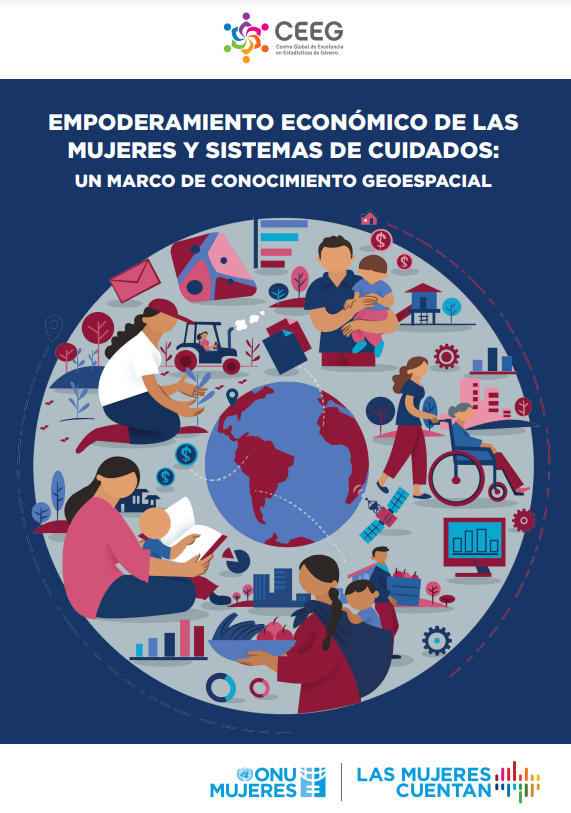
Women’s economic empowerment and care systems: a geospatial knowledge framework.
- Type
- Articles
- Country
- Mexico
- Types of care work
- Paid care work Unpaid care work
- Care and populations
- Children and adolescents Women
- Actors
- Civil society organizations International organizations National governments Private sector Sub-national and local governments Trade unions and trade associations
- Regions
- Latin America and the Caribbean
- Policies and actions
- Measurement and use of time
- Conceptual framework
- The 5Rs of care
Studies on women’s economic empowerment have received increasing attention in recent years, identifying the factors that limit and enable it, among which care systems are a key factor, because they have an impact on the reduction and redistribution of women’s unpaid domestic and care work. The differences in the time dedicated to these activities with respect to the time spent by men have repercussions on the persistence of gender gaps in the labor market. The study develops a methodological proposal for the integration, exploitation and use of statistical information related to women’s economic empowerment and care services, using a geospatial approach. The study provides a conceptual framework that integrates the antecedents of the analysis of economic empowerment with care systems, with a territorial perspective, using the case of Mexico. Through the estimation of correlations and an econometric model, it analyzes the relationship between women’s labor participation and income generation with labor market characteristics, individual and household characteristics, and the existence of social services that capture the characteristics of the environment, such as care systems. The study offers a subnational disaggregation of the results.

Author
Mónica Elizabeth Orozco Corona

Publisher
Centro Global de Excelencia en Estadísticas de Género (CEEG)
Continue reading
Related resources