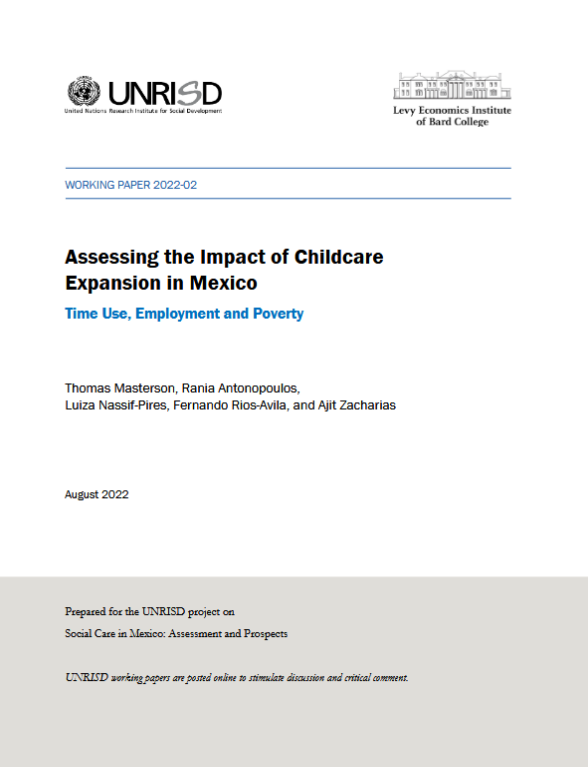
Assessing the Impact of Childcare Expansion in Mexico: Time Use, Employment and Poverty
- Type
- Reports
- Country
- Mexico
- Types of care work
- Domestic work Unpaid care work
- Care and populations
- Children and adolescents Women
- Actors
- International organizations
- Policies and actions
- Budgeting and financing Measurement and use of time Research and diagnostics Social security and protection
- Conceptual framework
- Care economy The 5Rs of care
Unpaid care work amounts to an astronomical figure of 2 billion hours per day in the world of which three quarters are performed by women. This reality explains, to a large extent, the little progress that has been seen in reducing gender gaps, as far as employment, wages and use time are concerned. Against this background, the so-called 3R strategy –the Recognition, Reduction and Redistribution of unpaid care work–has been accepted as the main policy intervention towards closing gender gaps (UN Commission on the Status of Women 2014). Based on a measurement method developed by the Levy Institute that combines time and income poverty (called LIMTIP), the authors of this report empirically analyze the net impact on well-being of the expansion of childcare services in Mexico. Specifically, they carry out a comprehensive evaluation with a gender perspective of job creation and income generation, changes in the paid and unpaid workload, and the risk that this may entail in terms of time poverty.

Author
Thomas Masterson

Author
Rania Antonopoulos
Project coordinator
Author
Luiza Nassif-Pires
Author
Fernando Rios-Avila
Author
Ajit Zacharias

Continue reading