
Seville marks a historic milestone: care enters the global financing agenda
FfD4 hosted the launch of the initiative “Investing in Care,” led by Mexico, Brazil, Colombia, UN Women, ILO, and the Global Alliance for Care, aiming to transform global financing by recognizing care as essential infrastructure for sustainable development.
Seville, July 2, 2025
The Fourth International Conference on Financing for Development (FfD4) served as the stage for the official launch of the initiative under the Seville Action Platform: “Investing in Care for Equality and Prosperity: A Global Initiative to Promote Gender-Responsive Development Financing.” Led by the governments of Mexico, Brazil, and Colombia, together with UN Women, the International Labour Organization (ILO), and the Global Alliance for Care (GAC), this initiative marks a turning point in global discourse: transforming the international financial architecture so that care is no longer invisible and is recognized as essential infrastructure for sustainable development.
The process began on July 1 with the official side event “Financing Care Systems for Gender Equality and Economic Prosperity: A Multi-Stakeholder Approach”, co-organized by Brazil, Chile, Mexico, UN Women, the Development Bank of Latin America and the Caribbean (CAF), Oxfam, the International Development Research Centre (IDRC), and the Global Alliance for Care. The event brought together government officials, multilateral organizations, and civil society in a united call to place care at the heart of public policies and investment systems. A day later, this vision took shape with the official presentation of the initiative at the Alliance’s Care Pavilion.
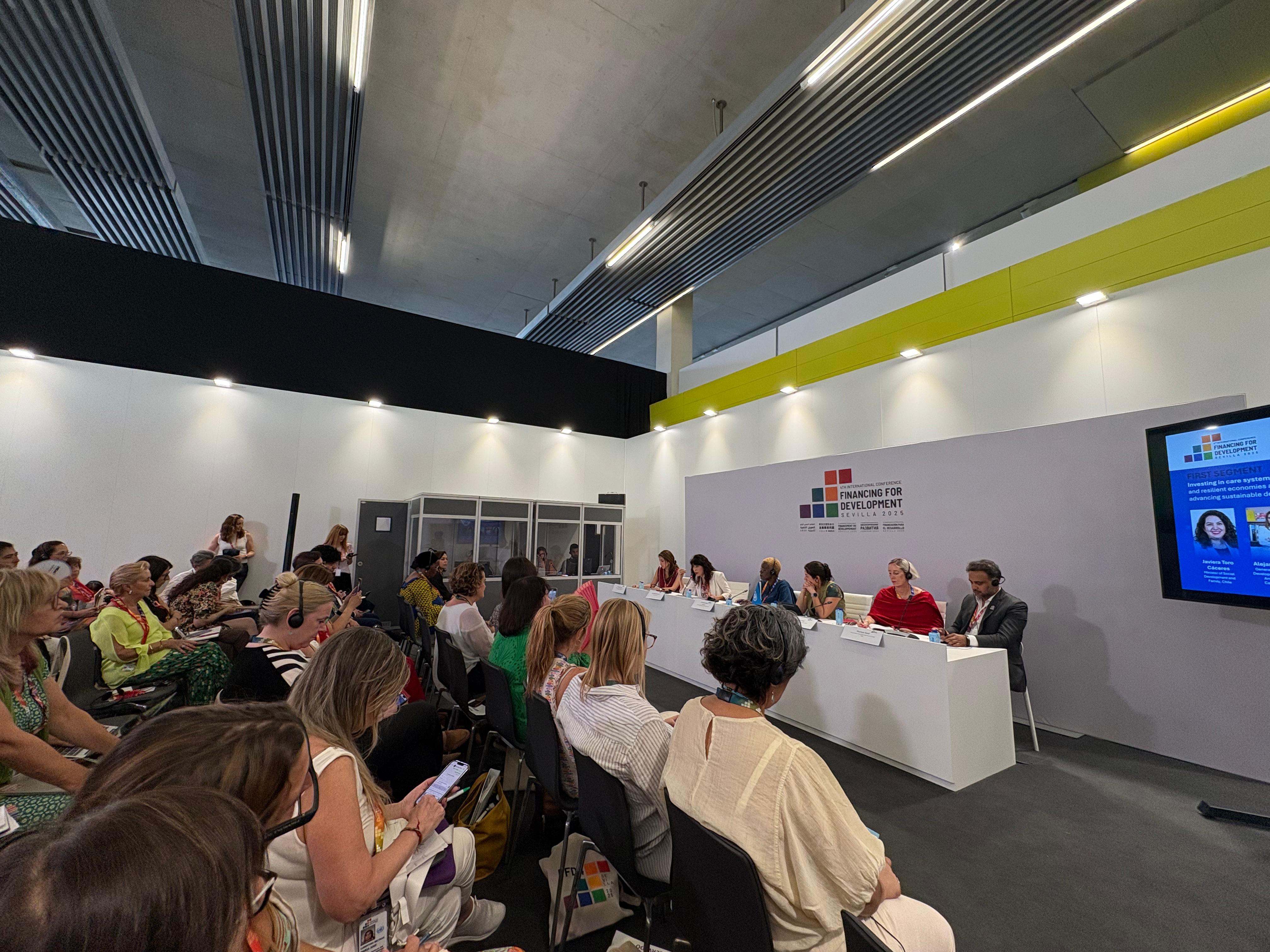
Photo caption: Side event at FIBES Conference Center: “Financing Care Systems for Gender Equality and Economic Prosperity: A Multi-Stakeholder Approach”
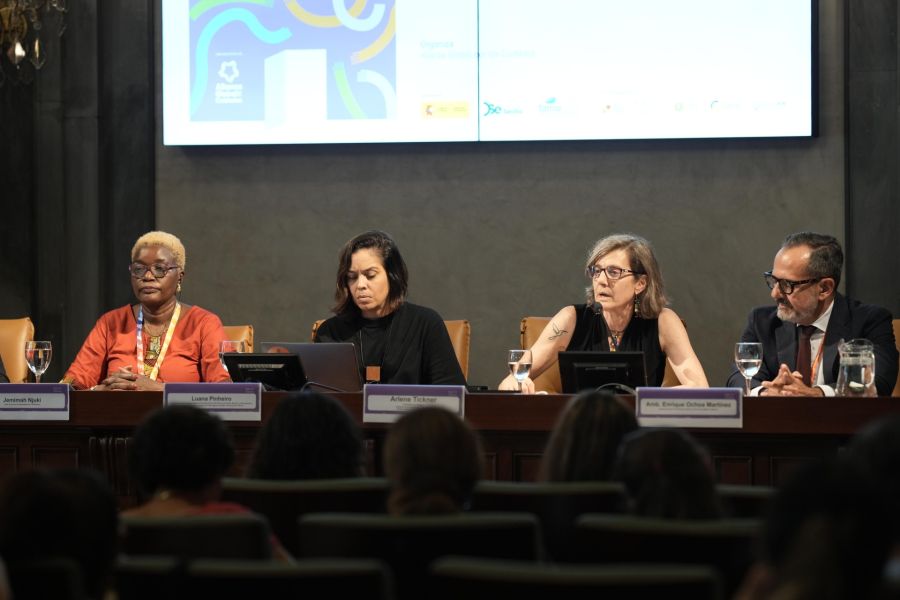
For Mexico, a co-leader of the initiative, this is a firm and strategic commitment. Enrique Ochoa Martínez, representative of the Government of Mexico, stated: “Our commitment to the care economy is rooted in our history, public policy, and vision for the future. This initiative affirms that care is not a cost — it is a strategic investment for inclusive development and social justice.”
From Brazil, Luana Pinheiro of the Ministry of Social Development highlighted the transformative power of this agenda: “Investing in care is not just social policy. It is economic, labor, environmental, and infrastructure policy with immense multiplying potential. This initiative promotes a shared responsibility among the state, civil society, and communities.”
Colombia contributed a territorial and South-South cooperation perspective. Arlene Tickner, Vice Minister for Multilateral Affairs, said: “Colombia advocates for a feminist foreign policy that puts care at the center. This initiative is a transformative platform linking gender, development, peace, and sustainability from an inclusive and territorial approach.”
Multilateral partners agreed that the Seville Action Platform marks a turning point in recognizing and financing care. Jemimah Njuki, Director of Programs at UN Women, emphasized: “The Seville Action Platform represents what comes after the declarations — it’s about moving from commitment to action. We celebrate a historic milestone where gender equality and investment in care are firmly integrated. We’re not starting from scratch — there’s a global community ready to move forward.”
The International Labour Organization (ILO) reaffirmed its commitment to labor rights in the care economy. Sara López González, technical advisor at the ILO in Spain, noted: “This initiative strengthens our mandate: promoting decent work in the care economy. To recognize, reduce, redistribute, reward, and represent care work is essential for gender equality and sustainable development.”
The Global Alliance for Care’s Technical Secretariat reinforced the message that “this initiative is grounded in a commitment to strengthen the Alliance’s work and strategic priorities, moving toward a global transformation that puts care at the center of our societies.”
During the launch, other states, multilateral bodies, and civil society representatives also stressed the urgency of advancing toward a care-centered economy. María Guijarro, Spain’s Secretary of State for Equality, declared: “Investing in care means investing in a fairer, more equitable, and more sustainable society. True shared responsibility requires a collective commitment to building a society of care.”
From UNDP, Raquel highlighted the need to “reform fiscal systems with a gender lens and ensure solid data to inform effective policy.”
Ana Güezmes of ECLAC warned of the region’s triple crisis — care, climate, and development — and called for sustained investment “to care for both life and the planet.”
From the IDB, Diana Rodríguez Franco noted: “This initiative allows us to mobilize key sectors like housing, transport, and employment around a shared care agenda.”
Alejandra Haas of Oxfam was clear: “Care must not remain a commodity. It is a right that must be guaranteed through public services and fair financing.”
Carolina Robino, Senior Program Officer at Canada’s International Development Research Centre (IDRC), emphasized the need to “link care to climate justice and channel investments through cooperation and local research.”
Finally, Camila Barretto Maia, international relations and human rights expert, reminded the audience: “The current distribution of care is deeply unequal and unsustainable. It demands structural reform based on a global feminist perspective.”
The impact of this initiative is already visible at FfD4. The Seville Commitment, the final document adopted by all Member States present, includes in Article 11 a call to increase investment in the care economy, recognize its value, and fairly redistribute the burden of unpaid care work, which disproportionately falls on women. This represents a key step toward a new economic model centered on the sustainability of life and human rights.
With backing from countries such as Spain, Uruguay, Canada, Norway, Germany, Nepal, the United Kingdom, Iceland, and Australia, as well as support from international organizations including CAF, ECLAC, UCLG, UNDP, UNFPA, IDRC, and IDB, and civil society organizations such as Oxfam, GIESCR, La Coordinadora, and Equimundo, the initiative “Investing in Care for Equality and Prosperity” serves as a roadmap to rethink global development through a feminist, intersectional, and human-centered lens. Through the Seville Action Platform, signatory countries commit to a collective and shared transformation, where care work is no longer invisible and takes its rightful place: at the center of our economies, policies, and lives.
In addition to this advocacy effort, throughout the week the Global Alliance for Care, with support from the Andalusian Fund of Municipalities for International Solidarity (FAMSI), the Seville Provincial Council, and the Spanish Ministry of Equality, organized the Care Pavilion at Casa de la Provincia. Designed as an open and inclusive space, the Pavilion has been a key platform for collective reflection, alliance building, and political momentum around the care agenda. Its program has included roundtables, exhibitions, multilateral meetings, and a working breakfast with Alliance members, becoming a driving force for dialogue and action to put care at the center of development.