
The Global Alliance for Care Advances Its Transformative Vision at Women Deliver 2026 through the Care Pavilion and the “Voices of Care” Booth
The Global Alliance for Care (GAC) and its members actively participated in Women Deliver 2026 through the Care Pavilion, the “Voices of Care” booth, and multiple sessions, reinforcing the role of care in the global agenda for equality and economic justice.
Over the course of five days at the Women Deliver 2026 Conference (WD2026), the Global Alliance for Care (GAC) and its membership played a prominent role in advancing care as a fundamental pillar for gender equality and gender justice. Through the Care Pavilion and the “Voices of Care” space, as well as multiple sessions held at the Melbourne Convention and Exhibition Centre (MCEC), the Alliance continued contributing to positioning care at the center of the global agenda on gender equality and economic justice.
The conference in Narrm (Melbourne) opened with a powerful call for collective action during its inaugural session, underscoring the urgency of the current moment amid ongoing conflicts, the climate crisis, setbacks in rights, and the rise of authoritarian narratives. In response, participating voices highlighted the collective power of women and feminist movements as “circuit breakers” capable of driving structural change. The need to “share as women, understand one another, and think globally” was placed at the forefront, alongside the importance of building solidarity, care, and mutual commitment as the foundation for progress. Within this context, care emerged as a central political concept: not as something secondary or “soft,” but as a rigorous and transformative practice deeply connected to justice and accountability.
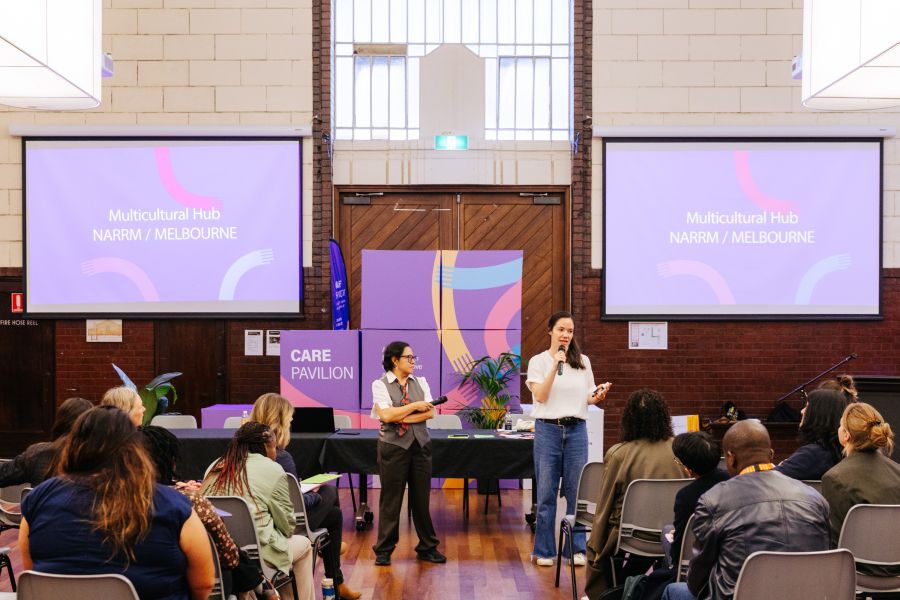
The Care Pavilion, located at the Multicultural Hub, has consolidated itself as an open, dynamic, and accessible space that throughout the week hosted participatory workshops, panels, exhibitions, cultural activities, and multi-stakeholder gatherings. Led by the Global Alliance for Care, with the support of the City of Melbourne, the International Development Research Centre (IDRC), and Fondation CHANEL, and in collaboration with CHANGE, Equimundo, and Women Deliver, the space served as a bridge between global advocacy and local realities. In the context of Women Deliver 2026, the Pavilion brought together policymakers, feminist organizations, social movements, grassroots women’s organizations, trade unions, the research community, and the general public, offering a city-rooted environment to place care at the center of debates on gender equality and economic justice, while fostering dialogue, exchange, and collaboration among diverse actors.
Throughout its programming, the Pavilion addressed key dimensions of the global care agenda, including the development of inclusive and resilient care systems; the links between care, economic justice, and urban economies; feminist approaches in contexts of conflict and crisis; and the role of public policy and the private sector. It also explored the intersections between care and climate action, health, disability, and ageing, as well as emerging issues such as the use of data and artificial intelligence in care systems. All of this incorporated community-based perspectives, Indigenous knowledge, and the engagement of men, reinforcing a vision of care as a human right, a public good, and a shared responsibility.
At the same time, the “Voices of Care” space, located within the Melbourne Convention and Exhibition Centre, amplified the voices, experiences, and proposals of Alliance members and allies within the conference exhibition area, strengthening the visibility of care and facilitating exchange with a diverse audience. . These materials will soon be shared on our social media channels.
In addition, numerous organizations within the Alliance actively participated in WD2026 through sessions held at the Melbourne Convention and Exhibition Centre. Collectively, these sessions addressed key issues such as engaging men in care and violence prevention, the care economy and economic justice, the development of more inclusive care infrastructures, gender-responsive climate action, and strengthening women’s leadership in community systems and local economies.
Organizations and working spaces connected to the economic justice and rights agenda played a particularly important role, including the Economic Justice and Rights Working Group, which contributed to organizing and developing two key sessions during the conference: one focused on building a strategic roadmap for economic justice across different global processes, and the plenary “Building Economies that Deliver: Care, Public Services, and Shared Prosperity.” Together, these sessions reinforced the links between care, public policy, and more equitable economic models, positioning care as a driver of systemic transformation.
Finally, the exhibition program of the Care Pavilion brought an artistic and community-based perspective on care across diverse contexts. The featured works addressed issues such as climate justice, the relationship between care, territory, and sustainability, new masculinities, the impacts of militarization, intergenerational care, and women’s collective knowledge. Altogether, these exhibitions expanded the conversation on care beyond public policy spaces, incorporating visual, testimonial, and community-rooted narratives.
The participation of the Global Alliance for Care in WD2026 reaffirms its commitment to building more just societies, where care is recognized, reduced, and redistributed equitably, as well as adequately rewarded and represented, and consolidated as a right, a public good, and a shared responsibility.
- View, download, and share all the photos in our Flickr gallery.
- Catch up on our daily coverage on LinkedIn.