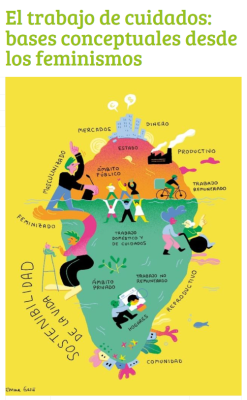
Care Work: Conceptual Foundations from a Feminist Perspective
The care sector is caught between two extremes, marked by rampant economic inequality. As explained by OXFAM (2020), we currently live under a flawed and sexist economic model. At the very top of this model sits a small, wealthy elite with unimaginable fortunes, who increase their wealth day by day with little effort, regardless of the value they may or may not add to society.
This exclusive elite consists of the wealthiest 1% of the population, who possess more than twice the wealth of 6.9 billion people. Within this same elite, for example, are the 22 richest men in the world, who possess more wealth than all the women in Africa (OXFAM, 2020). At the bottom of this model, meanwhile, are women and girls—especially those living in poverty or belonging to marginalized groups—who devote approximately 12.5 billion hours daily to unpaid care work, in exchange for living conditions that are far from empowering or dignified, and are closer to precariousness and the systematic violation of rights (OXFAM, 2020). However, the work performed by these women and girls is essential to the life of society as a whole. This work—that is, domestic and care work—is the foundation upon which the well-being of families rests, as well as the health and productivity of the workforce.
In this context, the following text aims to explore basic concepts surrounding the work that sustains the life and prosperity of households and communities: care. It will delve into the main contributions of the feminist movement to understand the social and economic importance of care work and reflect on what we can do collectively to build societies that place care at the center of all actions and decisions.