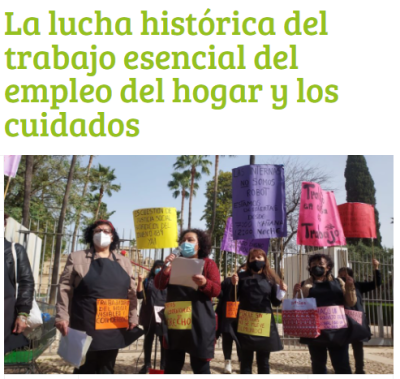
The long-standing struggle for recognition of essential work in domestic and caregiving roles
The article examines the long-standing struggle of domestic and care workers for the recognition of their labor and social rights. It explains how this work—performed primarily by women, and especially by migrant women—has historically been rendered invisible, made precarious, and regarded as a “natural” extension of women’s domestic duties. Despite performing work that is essential to sustaining life and the economic system, domestic workers have faced wage inequality, a lack of social protection, labor abuses, and a lack of political recognition.
The text also highlights the role of collective organization and the feminist movement in securing rights, driving advances such as the ratification of ILO Convention 189 and the recognition of care work as essential during the pandemic. Furthermore, it reflects on “global care chains,” where migrant women sustain the well-being of other families while facing conditions of vulnerability and exclusion. Finally, the article argues for the need to transform the current social and economic model to place care at the center, recognizing it as a collective right and a shared responsibility among the state, society, and families. It maintains that ensuring decent working conditions for caregivers is essential to building a more just and equal society.