
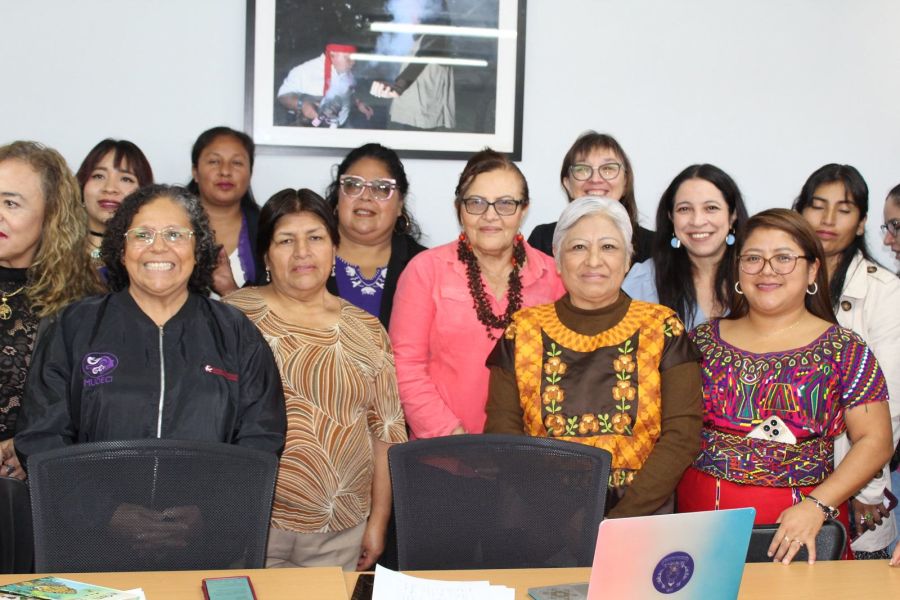
The Care Pavilion focuses on domestic work, climate justice, and feminist leadership on its fourth day in Mexico City
Mexico City, August 13, 2025 — The Care Pavilion, promoted by the Global Alliance for Care, experienced an intense day today that intertwined territorial experiences, political debates, and intersectional perspectives, within the framework of the XVI Regional Conference on Women.
Mexico City, August 13, 2025 — The Care Pavilion, promoted by the Global Alliance for Care, experienced an intense day today that intertwined territorial experiences, political debates, and intersectional perspectives, within the framework of the XVI Regional Conference on Women in Latin America and the Caribbean.
From Wednesday until Friday, August 15, the program will take place at its new headquarters, the Nezahualcóyotl Center for Intercultural Studies, with a shuttle service connecting this space with the official headquarters of the Regional Conference and the City of Care. The latter, provided by the Government of Mexico City, maintains an agenda open to all citizens with services such as care for the elderly, safe spaces for children, self-care for women caregivers, rehabilitation, a public dining hall, health services, activities for men, and a craft market, among others.
The morning at the new headquarters began with the presentation of the study “Domestic work and care work”, which highlighted the urgent need to recognize and professionalize these essential tasks. At the same time, the dialogue “Contributions of rural and urban community caregivers to sustainable development” highlighted how these networks sustain local economies and strengthen the social fabric.
The MenCare Advocacy Lab workshop also took place, bringing together advocates, policymakers, researchers, and professionals from Central and South America to reflect on the role of men in caregiving.
The report “Feeding is caring” was presented in the Auditorium Hall, highlighting the role of indigenous and Afro-descendant women in food production and harvesting as an essential part of community care. The rights-based approach was present in the session “Time and rights for women and persons with disabilities”, led by the UNDP, which raised the urgency of designing inclusive care systems. Next, the panel “Caring from the Territory” analyzed community infrastructures and practices in different countries in the region, while “People with Disabilities in Care and Support Systems” defended independent living as a right.
In the afternoon, the discussion “The challenges of care policies from a feminist perspective” brought together regional organizations to debate how to transform care systems based on substantive equality. This was followed by “Psychoactive substance use and gender”, which focused on public health and destigmatization, and “Care is also work”, which called for labor policies that recognize these tasks.
ISOQuito was presented at the headquarters of the City of Care, with an assessment of progress and pending issues in gender commitments in the region. Later, the book “The Right to Social Security and Care Responsibilities” was presented, and a dialogue on “Community Care Systems” was held, highlighting the experiences of signatories to the Peace Agreement in Colombia. Both events agreed that care is a right and a shared responsibility, and that community initiatives strengthen peace, gender equality, and social justice.
One of the highlights of the day was the dialogue “Towards climate justice focused on care”, which integrated feminist, environmental, and human rights perspectives to address the climate crisis. Finally, “Feminist reflections on cultural change in the care society” closed a day that reaffirmed the Pavilion as a key space for transforming narratives and policies around care.
Thursday, August 14 – Highlighted Agenda
- 8:30 – 10:30 h General Assembly of the Global Alliance for Care – Auditorium Nuestra Casa / Ve’e Yo
- 11:30 – 13:15 h Care and support: challenges and opportunities for a gender- and disability-inclusive agenda – Auditorium Nuestra Casa / Ve’e Yo
- 12:00 – 12:30 h Workshop: “Looking at ourselves” – “Águila / Cuauhtli” Room
- 12:00 – 13:30 h Dialogue on Economic Justice, Care, and the Elimination of Violence – “Conejo / Awani” Room
- 12:00 – 13:30 h “Seeds of Care”: Collective Parenting for Wounded Territories – “Pájaro / Tsin Su” Room
- 13:00 – 15:00 h Training and Certification in the Professionalization of a Public Care System – “Águila / Cuauhtli” Room
- 13:30 – 14:30 h Educating through art: the legacy of Gabriela Mistral and Rosario Castellanos toward equality and social justice – Auditorium Nuestra Casa / Ve’e Yo
- 13:45 – 15:45 h Dialogue on care policies in the multilateral agenda – “Pájaro / Tsin Su” Room
- 14:00 – 15:30 h Mental health from a gender perspective: resistance, care, and autonomy – Ciudad de los Cuidados
- 15:00 – 16:30 h Towards just transitions centered on care: feminist proposals in the face of the climate crisis – Auditorium Nuestra Casa / Ve’e Yo
- 15:00 – 16:30 h Community Care for Good Living: experiences and challenges – “Águila / Cuauhtli” Room
- 16:00 – 17:00 h Domestic work, a fundamental component of the care economy – “Conejo / Awani” Room
- 16:00 – 17:30 h The perspective of young feminists in Latin America on care policies – “Pájaro / Tsin Su” Room
- 17:00 – 18:00 h Community care as a common good. Weaving networks of collective care – “Perro / Peek” Room