With your permission we measure how the site is used and show content from other services: Google Maps, YouTube, Spotify. Accept or reject all of it, or choose in your preferences. You can change this at any time from Privacy preferences at the foot of every page. Privacy policy
This publication examines emerging goodpractices of market-based models in the digitallyenabled care economy in Southeast Asia andidentifies pathways towards decent work for thepredominantly female workforce.The care economy entails the production andconsumption of goods and services necessary forthe physical, social, mental…
This policy brief examines the low rate of female labour force participation in Asia and the Pacific and its correlation with persistent inequalities in the distribution of care responsibilities between men and women as well as the society and the…
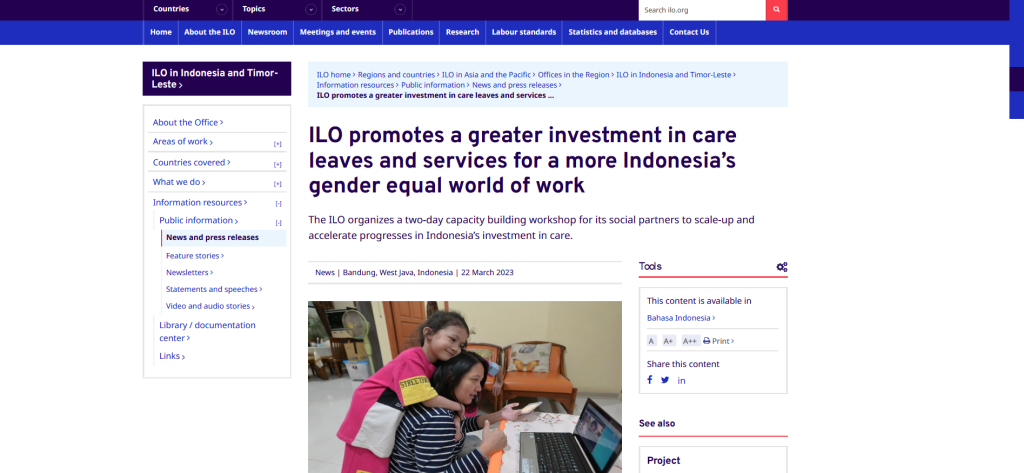
The ILO launches its new report on care at work, highlighting the benefits of investing in care services and policies to alleviate poverty, encourage gender equality and support care for children and the elderly in Indonesia.
This primer is designed to support policymakers and government officials in their efforts to achieve Sustainable Development Goal 5 on gender equality and empowerment of women in their countries. It lays out the basic concepts relating to what is called…
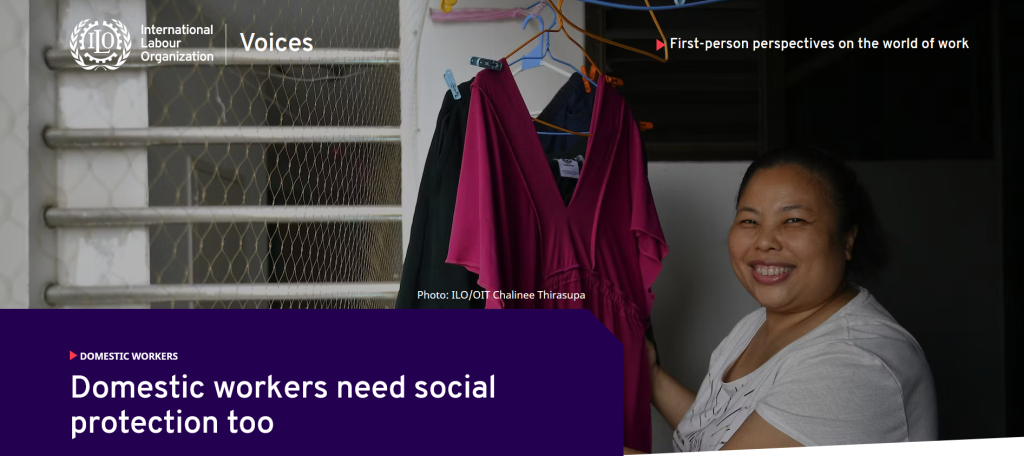
My name is Champa. I grew up in a village in Myanmar. When I was five years old my father died. I am the youngest of nine children, and as a daughter, I was the one who had to help…
Following to a tripartite social dialogue on care economy held in early March, the ILO conducted a two-day capacity building workshop in Bandung, West Java, from 16-17 March. The workshop was targeted to representatives of relevant ministries, employers’ and workers’…
This report describes the state of the unpaid care economy in ASEAN countries. By examining the socioeconomic, political, legislative and institutional conditions in each country of ASEAN, this report highlights examples of promising policy measures undertaken either prior to the…
The publication of this report, in the midst of a devastating global health pandemic, could not have come at a more critical time for domestic workers. This crisis has highlighted the vital role that they play in supporting the care…
This research would not have been completed without the perseverance and dedication of those who participated in the collection and validation of the data as well as in the preparation of the report. Undertaking a study amidst the mobility restrictions…
Women in Asia and the Pacific work the longest hours in the world. On average, women in the region worked 7.7 hours daily, of which only 3.3 hours are paid, and the rest are dedicated to unpaid care work. If…
This report contributes to understanding how care policies are being implementedin the Global South – in Sub-Saharan Africa, Asia and the Pacific, and Latin Americaand the Caribbean –, as well as the elements that have the potential to make themtransformative.…
The authors take a close look at unpaid work using data from China’s first large-scale time use survey (TUS) conducted in 2008. They document the gender patterns of time allocation over three activities: paid work, unpaid work and non-work activity…