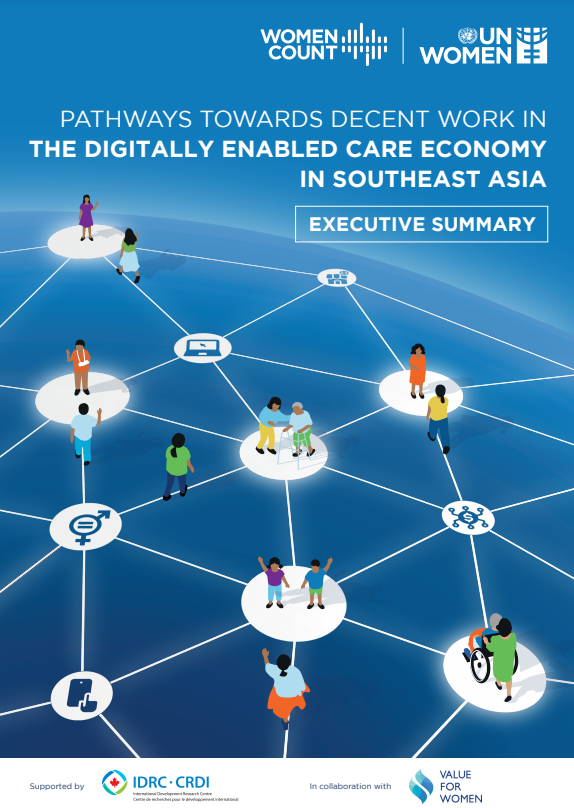
Pathways Towards Decent Work in the Digitally Enabled Care Economy in Southeast Asia
- Type
- Reports
- Country
- Indonesia Philippines Thailand
- Actors
- International organizations
- Regions
- East and Southeast Asia
- Policies and actions
- Comprehensive care systems Technology and digital innovation
- Conceptual framework
- Care economy Global care chains
This publication examines emerging goodpractices of market-based models in the digitallyenabled care economy in Southeast Asia andidentifies pathways towards decent work for thepredominantly female workforce.The care economy entails the production andconsumption of goods and services necessary forthe physical, social, mental and emotional wellbeing of care-dependent groups. These includenot only children, the elderly, the ill and peoplewith disabilities, but also healthy, prime workingage adults. Caregiving services, both direct andindirect, can be provided for pay or without payfor the final use of family and household members.Information and communication technology(ICT) has been used to transform all areas ofpeople’s lives, including the delivery of careservices. Increasingly, a variety of business modelsleveraging digitalization, such as online platformsand applications (apps), facilitate the matchingof demand and supply in the care economy. Thisreport defines this as the “digitally enabled careeconomy”, which refers to workers and enterpriseswho are in a work relationship with clients procuringservices. Two elements characterize this workrelationship: technology and the tripartite natureof the relationship between the enterprise, workerand client. The report refers to the organizationsthat work within the economy as “digitally enabledcare enterprises” (DECEs) and the people who areproviding the care services as “digitally enabledcare workers” (DECWs).

Author
Cecilia Tinonin
Author
Katja Freiwald
Author
Erin Watson
Author
Amy Baum
Author
Feroza Sanjana
Editor
Andy Quan


Continue reading